



Not medical advice — written by Ngoc Vietsmall, who is not a healthcare professional.
This article summarises publicly available medical information for general readers. It cannot account for your history, medication or symptoms, and it is not a diagnosis or a treatment plan. Any dose mentioned comes from published labelling or guidelines — only your own prescriber can decide what is right for you.
Always speak to a doctor or pharmacist before starting, stopping or changing any treatment. If symptoms are severe or getting worse, seek urgent care. Full disclaimer · How this is written
Hey there! This article is for informational purposes only and does not constitute medical advice. If you or a loved one are experiencing symptoms that may indicate a heart attack, it is critical to seek emergency medical care immediately. For a STEMI (ST‑segment Elevation Myocardial Infarction), the product label and clinical guidelines describe a standard ticagrelor loading dose of 180mg, followed by 90mg twice a day for up to a year, but only the treating prescriber determines the appropriate dose for each individual. That's the core of what this article covers, and it unpacks the why, the when, and the what‑ifs.
Ready? Grab a coffee (or a glass of water) and let's dive into the details – no fluff, just friendly, useful information.
Quick Summary
What does the label say about the loading dose?
The product label for ticagrelor states a loading dose of 180mg given as soon as possible, then 90mg every 12 hours. This rapid loading is designed to inhibit platelets quickly, which is critical when a coronary artery is blocked. However, the exact timing and dose are determined by the treating clinician.
When is the next dose typically scheduled?
The label suggests that the first 90mg maintenance dose can be given 6‑12 hours after the loading dose, or after a procedure, depending on the patient's condition and the clinician's plan.
Why Loading Matters
What is a loading dose?
A loading dose is a larger initial amount intended to quickly raise drug levels. For ticagrelor, the 180mg dose is designed to achieve rapid platelet inhibition – typically within 30 minutes, which is quicker than older agents like clopidogrel.
Why is speed crucial in STEMI?
STEMI is a race against time. Rapid platelet inhibition may help keep the clot from growing while the interventional cardiologist works on opening the vessel. The 2024 ESC STEMI guideline emphasizes that early, potent antiplatelet therapy is associated with improved reperfusion success and reduced mortality.
Loading vs. Maintenance (at a glance)
| Stage | Dose (per label) | General timing (prescriber decides exact) | Goal |
|---|---|---|---|
| Loading | 180mg (single) | As soon as possible | Rapid platelet inhibition |
| Maintenance | 90mg twice daily | Typically 6‑12h after loading, then every 12h | Sustained antiplatelet effect for up to 12 months |
Official Dosing
Standard regimen for STEMI
Across the major societies – ACC/AHA, ESC, NICE – the described regimen is the same: 180mg loading followed by 90mg twice a day. This is the commonly referenced ticagrelor STEMI dose. The dosing does not change based on age, weight, or gender according to the label, although healthcare professionals monitor closely for bleeding or dyspnea.
Special circumstances
Renal impairment: The label does not require a dose reduction, but bleeding is monitored.
Elderly (>75y): The same dose is described, with monitoring for shortness of breath.
Concomitant anticoagulants: Timing is typically coordinated to avoid excess bleeding – often the antiplatelet is given after the anticoagulant infusion is completed, as determined by the care team.
When to start the maintenance dose
Most protocols describe the first 90mg dose 6‑12 hours after the 180mg loading. If the patient is undergoing primary PCI and cannot swallow, the chewable form of ticagrelor (Brilinta) may be administered via a nasogastric tube, and the first maintenance dose can be given immediately after the procedure, per the clinician's judgment.
NSTEMI & PCI Scenarios
Ticagrelor loading dose in NSTEMI
Even when the heart attack is not ST‑segment elevation, the same 180mg loading dose is described. Evidence suggests no loss of efficacy, and earlier platelet inhibition is associated with better outcomes, especially for those headed for an early invasive strategy.
Loading for PCI‑only procedures
When preparing for elective PCI, the practice described is still to give a 180mg loading dose before the cath lab, then follow the usual maintenance schedule. Compared with clopidogrel's 300‑600mg loading, ticagrelor's rapid onset may be associated with fewer periprocedural thrombotic complications.
Quick comparison table
| Drug | Loading Dose (label) | Time to 30% Platelet Inhibition | Maintenance (label) |
|---|---|---|---|
| Ticagrelor (Brilinta) | 180mg | 30min | 90mg twice daily |
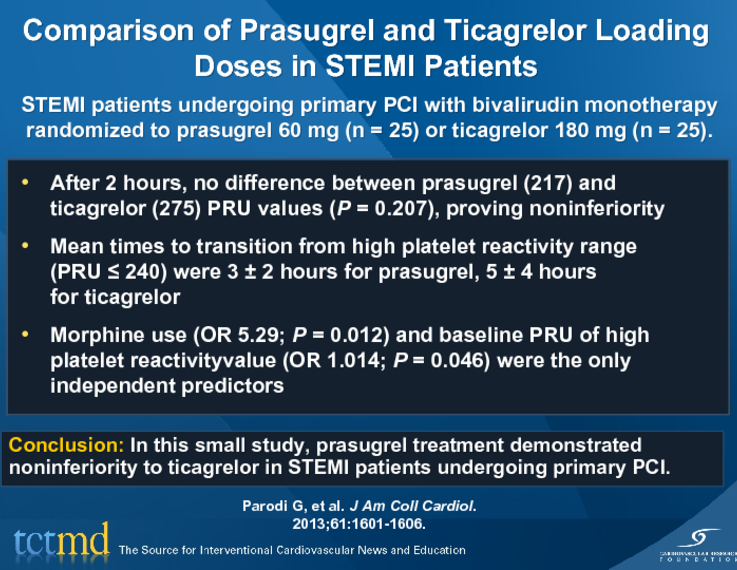
| Prasugrel | 60mg | 1h | 10mg daily |
| Clopidogrel | 300‑600mg | 2‑6h | 75mg daily |
High‑Dose Debate
Is a double loading dose better?
Some early trials explored a 360mg double loading dose, hoping for even faster platelet shutdown. The data (see a PLATO trial subanalysis) showed a modest improvement in inhibition at 30 minutes but no clear benefit in mortality or major bleeding. In short, a higher dose is not necessarily better.
Safety concerns
The biggest tradeoff with a higher dose is bleeding. While the 180mg loading is already associated with a small increase in non‑procedural bleeding compared with clopidogrel, the 360mg regimen pushes that risk higher without a proven upside. Most guidelines therefore stick with the single 180mg loading.
Benefits & Risks
Primary benefits
- Rapid platelet inhibition: Helps keep the clot from expanding during the critical minutes before the artery is opened.
- Mortality reduction: The PLATO trial reported a 5‑6% relative reduction in cardiovascular death compared with clopidogrel – though individual results vary.
- Consistency across populations: The drug has been studied in diabetics, the elderly, and patients with renal dysfunction.
Common side effects
- Dyspnea: A feeling of shortness of breath that can be unsettling, but is usually mild and often resolves with continued therapy.
- Bleeding: From easy bruising to gastrointestinal hemorrhage – any unusual bleeding should be discussed with a doctor.
- Bradyarrhythmia: Rare, but may be a concern for those with preexisting heart block.
Real‑world vignette
John, a 58‑year‑old truck driver, called 911 when he felt crushing chest pain. EMS arrived within minutes, gave aspirin, and administered a 180mg ticagrelor tablet en route to the cath lab. By the time he reached the catheterization suite, his platelets were already significantly inhibited, which helped the interventional cardiologist achieve a clean, fast reperfusion. John's story illustrates how a timely loading dose can be associated with a positive outcome.
Practical Steps for Clinicians
Loading Dose Considerations
Healthcare teams typically follow a process that includes confirming the diagnosis (with ECG and biomarkers), checking for contraindications, administering the loading dose (and documenting the exact time), planning the first maintenance dose, and monitoring for dyspnea, bleeding, or bradycardia. These steps are for qualified professionals to consider.
Integrating into DAPT (dual antiplatelet therapy)
Standard DAPT after a STEMI is aspirin plus ticagrelor. The aspirin dose is usually 81mg daily. The combination often continues for at least 12 months unless bleeding risk dictates otherwise. If a patient requires long‑term anticoagulation (e.g., for atrial fibrillation), the antithrombotic regimen becomes more nuanced, and a cardiology consultation is essential.
Key Questions (Featured‑Snippet Friendly)
What is the exact ticagrelor loading dose for STEMI?
According to the product label, 180mg taken as a single oral dose, as soon as possible after diagnosis – but the prescriber determines the final decision.
Can the loading dose be given before PCI?
Yes – the label and guidelines describe giving it before or at the start of primary PCI to ensure rapid platelet inhibition, with timing confirmed by the care team.
Is a 360mg loading dose ever recommended?
Current guidelines do not endorse a double loading dose; the benefit is unclear and bleeding risk rises.
When should the first maintenance dose be taken?
The label describes taking the first 90mg dose 6‑12 hours after the loading dose, then 90mg every 12 hours for up to a year – but the clinician sets the exact schedule for each patient.
How does the ticagrelor dose differ in NSTEMI?
The same 180mg loading dose is described; timing may be slightly less urgent than in STEMI.
What if a patient can't swallow tablets?
The chewable formulation of Brilinta may be used, or it can be administered via a nasogastric tube, as determined by the treating clinician.
Do I need to adjust the dose for renal failure?
According to the label, no adjustment is needed, but vigilant monitoring for bleeding is advised.
Conclusion
Understanding the ticagrelor loading dose in STEMI is not just about memorizing numbers – it's about grasping why those numbers matter. A 180mg loading dose given promptly, followed by 90mg twice a day, is described as providing rapid platelet inhibition that evidence suggests can be associated with better recovery. While the drug offers powerful benefits, it also brings real‑world risks like bleeding and dyspnea, so healthcare professionals must weigh each patient's profile carefully.
This article has walked through the science, the guidelines, the what‑ifs, and even a real‑life story to bring this into context. If you are a patient, discuss any concerns with your heart team – ask about timing, side effects, and what to expect after discharge. If you are a provider, keep these considerations in mind and stay updated with the latest ESC and ACC guidance.
Let's keep the conversation going: have you or someone you know navigated a STEMI with ticagrelor? What questions still linger? Knowledge shared is health saved.








