Not medical advice — written by Ngoc Vietsmall, who is not a healthcare professional.
This article summarises publicly available medical information for general readers. It cannot account for your history, medication or symptoms, and it is not a diagnosis or a treatment plan. Any dose mentioned comes from published labelling or guidelines — only your own prescriber can decide what is right for you.
Always speak to a doctor or pharmacist before starting, stopping or changing any treatment. If symptoms are severe or getting worse, seek urgent care. Full disclaimer · How this is written
Got a lab report that shows a low TSH and youre wondering if its serious? In secondary (or central) hypothyroidism the thyroid isnt the troublemaker its the pituitary or hypothalamus thats sending the wrong signals. The short answer: a low or inappropriately normal TSH together with a low free T4 usually means secondary hypothyroidism, and youll need more than just a TSH number to track treatment.
What Is Secondary
Definition and the central twist
Secondary hypothyroidism is a thyroid problem that starts above the gland. Think of the pituitary as the boss of the thyroid; if the boss is sick, the thyroid cant do its job even though its perfectly fine. This is why the condition is also called central hypothyroidism.
How it differs from primary hypothyroidism
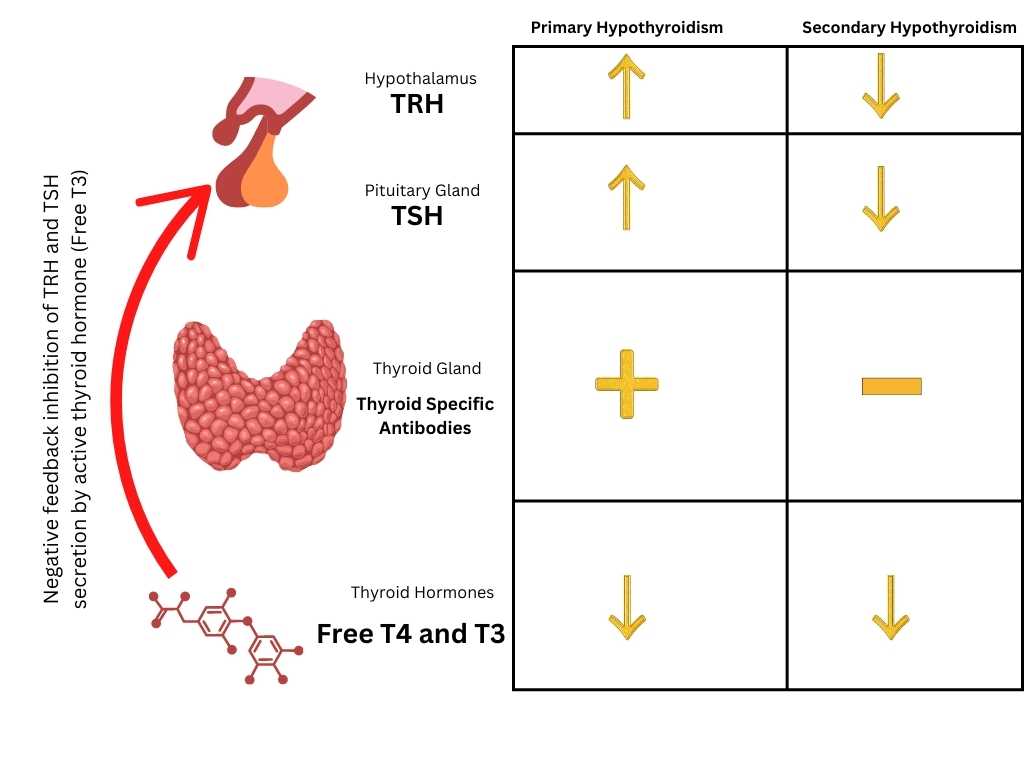
In primary hypothyroidism the thyroid itself is underactive, so the pituitary cranks up TSH (thyroidstimulating hormone) to try to wake it up. In secondary hypothyroidism the boss is slack, so TSH may be low, normal, or only slightly high and it cant be trusted to tell you how the thyroid is doing.
Primary vs. Secondary Comparison
| Aspect | Primary Hypothyroidism | Secondary (Central) Hypothyroidism |
|---|---|---|
| Problem Origin | Thyroid gland itself | Pituitary or hypothalamus |
| Typical TSH | High (above reference range) | Low, normal, or mildly high |
| Free T4 (FT4) | Low | Low |
| Treatment Monitoring | TSH is reliable | FT4 and symptoms are key |
Lab Patterns Explained
Typical TSH and T4 results
When doctors suspect secondary hypothyroidism they usually order a thyroid panel: TSH, free T4 (FT4), and sometimes free T3 (FT3). The classic pattern looks like this:
- TSH: Low or inappropriately normal
- FT4: Low
Because the pituitary isnt sending the right wakeup signal, TSH cant be used alone to gauge how the thyroid is functioning.
When TSH looks normal or even a bit high
It can feel like a paradox, but a slightly elevated TSH doesnt rule out secondary disease. The pituitary might still be damaged enough that it cant increase secretion proportionally, leading to a borderline TSH that hides the underlying problem. Thats why UCLA Healths pituitary guide stresses the importance of evaluating FT4 alongside TSH.
Why TSH isnt the best monitor
In primary hypothyroidism, adjusting levothyroxine to keep TSH in range works like a thermostat. In secondary hypothyroidism the thermostat is broken, so you watch the temperature (FT4) directly. Overreliance on TSH can lead to undertreatment, lingering fatigue, and that frustrating still not feeling right feeling.
Sample lab report
| Test | Result | Reference Range | Interpretation |
|---|---|---|---|
| TSH | 0.7 IU/mL | 0.44.0 IU/mL | Lownormal, inappropriate for low FT4 |
| Free T4 | 0.6 ng/dL | 0.81.8 ng/dL | Low consistent with secondary hypothyroidism |
Common Causes
Pituitary tumors
Noncancerous adenomas are the most frequent culprits. As they grow, they press on healthy pituitary cells, dampening TSH production. Rarely, a malignant tumor can do the same.
Postsurgical or radiation damage
Anyone whos had brain surgery near the sellar region or received radiation for a pituitary tumor may develop secondary hypothyroidism months or years later.
Infiltrative diseases
Conditions like sarcoidosis, hemochromatosis, or Langerhans cell histiocytosis can infiltrate the pituitary, impairing hormone output.
Trauma and Sheehans syndrome
Severe head injury or massive postpartum hemorrhage can starve the pituitary of blood, leading to pituitary shutdown a classic cause of secondary hypothyroidism.
Realworld vignette
Emily, a 32yearold mother, felt constantly exhausted after a difficult delivery. Her doctor ordered a thyroid panel; TSH was 1.2 IU/mL (normal) but FT4 was 0.7 ng/dL (low). An MRI later showed a small pituitary infarct classic Sheehans syndrome. Once she started levothyroxine and proper pituitary hormone replacement, her energy returned.
Key Symptoms
Overlap with primary hypothyroid signs
Fatigue, cold intolerance, dry skin, weight gain, and hair loss are common to both. If youve experienced any of these for weeks on end, a simple blood test can start the puzzlesolving process.
Pituitaryspecific clues
- Low libido or menstrual irregularities (low gonadotropins)
- Difficulty managing stress or low blood pressure (adrenal insufficiency)
- Growthrelated issues in children (low growth hormone)
Symptom checklist (feelfree to print)
- Persistent tiredness that rest doesnt fix
- Feeling unusually cold, even in warm rooms
- Unexplained weight gain or difficulty losing weight
- Dry, rough skin or hair loss
- Irregular periods or reduced sexual desire
- Episodes of dizziness or low blood pressure
Diagnosis Steps
Baseline blood work
Doctors start with a comprehensive panel: TSH, FT4, FT3, cortisol, prolactin, and sometimes IGF1 (growth hormone marker). This helps differentiate isolated secondary hypothyroidism from a broader pituitary deficiency.
Dynamic testing the TRH stimulation test
TRH (thyrotropinreleasing hormone) is administered intravenously. In a healthy pituitary, TSH spikes sharply within 1530 minutes. In secondary disease the rise is blunted or absent. The test isnt routine but can be decisive when labs are equivocal.
Imaging MRI of the sellar region
When labs suggest a central problem, an MRI looks for tumors, cysts, or structural damage. According to the UCSF Pituitary Center, MRI is the gold standard for visualizing pituitary lesions.
Diagnostic flowchart
| Step | Action | Result Next Step |
|---|---|---|
| 1 | Thyroid panel (TSH, FT4) | Low FT4 + low/normal TSH go to 2 |
| 2 | Check other pituitary hormones | Abnormal other hormones MRI (step 3) |
| 3 | MRI of pituitary | Lesion found treat underlying cause |
Treatment Options
Thyroid hormone replacement
Levothyroxine remains the firstline medication. Because TSH isnt reliable, doctors aim for a target FT4 that sits in the midreference range and look for symptom improvement. Dosing often starts low (2550 g) and is adjusted every 46 weeks.
Managing the underlying pituitary issue
- Surgery: Transsphenoidal removal of a tumor can restore pituitary function if the lesion is resectable.
- Radiation: For residual or inoperable tumors, focused radiotherapy can shrink tissue over months.
- Hormone replacement: If the pituitary cant produce ACTH, LH/FSH, or GH, doctors add cortisol, sex steroids, or growth hormone as needed.
Monitoring progress
Instead of chasing a TSH target, youll check FT4 every 6 weeks after a dose change, then every 612 months once stable. Keep a symptom diary energy levels, temperature tolerance, mood because those are the real markers of success.
Typical monitoring schedule
| Time Point | Lab Test | Goal |
|---|---|---|
| 6 weeks | FT4 | Midreference range (1.21.5 ng/dL) |
| 3 months | FT4 + symptom review | Stable FT4, symptom improvement |
| 612 months | Annual FT4 | Maintain target, adjust if needed |
FAQs Snapshot
What TSH level indicates secondary hypothyroidism?
There isnt a single magic number. In secondary disease, TSH is often low or inappropriately normal while FT4 is low. That mismatch is the red flag.
Can I rely on a home TSH test kit?
Home kits only measure TSH, so they can miss secondary hypothyroidism entirely. A full thyroid panel ordered by a clinician is essential.
How quickly does FT4 improve after starting levothyroxine?
Most people see FT4 rise within 24 weeks, but feeling fully better can take several months because the body needs time to adjust to the new hormone levels.
Is secondary hypothyroidism curable?
While hormone replacement controls the thyroid deficiency, the underlying pituitary cause (tumor, injury, etc.) may be treatable or may require lifelong management. Most patients stay on levothyroxine for life.
Do I need repeat MRI scans after treatment?
Only if symptoms change or labs suggest tumor growth. Routine MRI isnt required for every patient on stable hormone therapy.
Bottom Line & Next Steps
The key takeaway is simple: in secondary hypothyroidism the TSH number can be misleading, so doctors focus on FT4 and how you feel. If your recent labs show a low FT4 with a TSH that isnt soaring, ask your endocrinologist about a pituitary evaluation an MRI, maybe a TRH test, and a full hormone panel.
Take action now: schedule an appointment, bring your lab results, and discuss whether a pituitary workup is right for you. Understanding the story behind the numbers puts you back in control and helps you move from always tired to finally feeling like yourself again.